


Welcome to Chapter One of Book Two: Mudborn. This is the second installment of what will be a four-part series, Tales of the Twelve Realms. Read Chapter One of Book One: Adamantine here.
The Kickstarter for Book One is ongoing, ending January 11! Support the effort here!
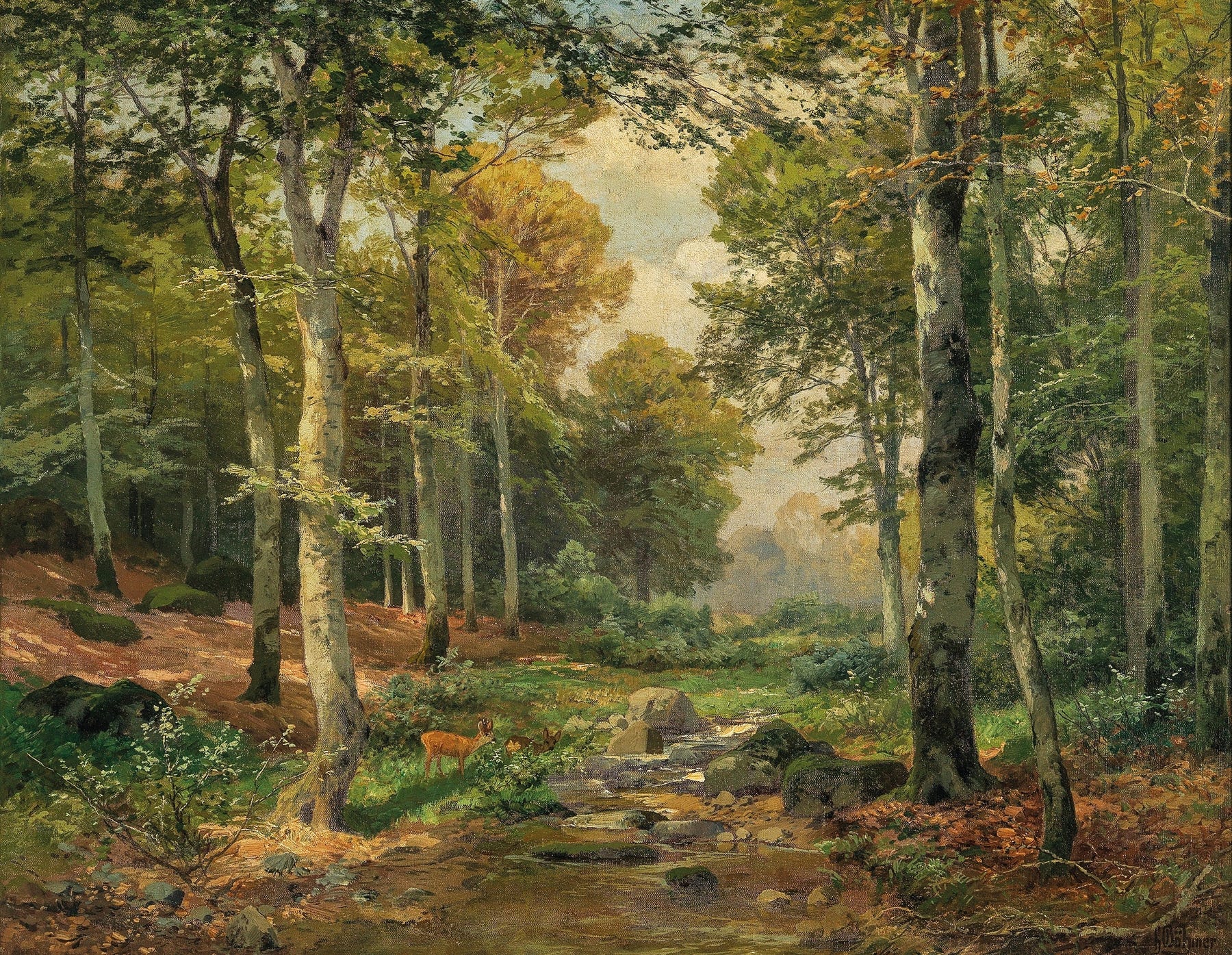
The forest was quiet.
Aspen waited, her bow drawn. The stag would face her soon. Then, she would let the arrow fly.
His head was down. He bit off grass with a yank of his head, stepping forward to the next clump of green.
A fly buzzed around her head, landing above her eye. She resisted the urge to shake it off or brush it away. Any movement would startle the stag, and all this waiting would be wasted.
He lifted his head, exposing his neck and shoulder. She loosed the arrow.
He turned his head and saw her, right before the arrow struck. He jerked at the impact, stutter-stepping backward, then jumped up before collapsing to the ground.
Aspen’s stomach rumbled as she emerged from the brush and approach the fallen creature. She slung her bow over her back, string in front of her. It had been months since she’d had venison, and she was getting quite tired of silvertrout for every meal. She hoped she’d be able to figure out a way to smoke the meat; she’d seen her uncle Rowan do it many times, so she knew the basics, and might be able to figure it out. Otherwise, most of this meat would go to waste. She could not eat it all herself before it spoiled.
She knelt down by the animal and drew her knife. Despite her hunger, her stomach turned a little bit at the thought of having to carve it up. She would have to carry it back to the lodge in pieces. At home, butchering time was her least favorite time of year. When the pigs were slaughtered and the whole family worked on putting up the meat - smoking bacon and ham, making sausage - the day would end with everything smelling of blood. She’d wash and wash, and still be able to smell the raw meat on her hands.
But hunger made a lot of things more tolerable. She was tired of feeling that fear in her belly every morning, wondering if she’d be able to find enough food for the day; exhausted from worry over the coming winter, and how she would survive here in the mountains by herself without any reserves.
She had a vague idea of how she should skin the deer, trying to remember the times when she saw her uncle Thomas do it. He would hang it on the frame behind the house, the same one he used to hang up the pigs. He would make cuts around each of the hooves, around the neck. He would slice up each leg and down the belly. Then he would just peel back the hide. He made it look easy.
“Here goes,” she muttered. She began making the cuts, hesitating before the blade came down. Her cuts didn’t look neat, and the blade was losing its sharpness. She didn’t have a whetstone, and cleaning so many silvertrout almost daily hadn’t done it any favors. She hated the way it felt as she sawed it on the skin of the stag. Smoked venison. Just think of smoked venison.
After what felt like hours later, she’d managed to peel back the skin on the front part of the body and remove the innards. The knife made the work so slow, and it was almost enough to make her want to give up. She’d gotten this far, though, and couldn’t stop now.
It was getting dark by the time she finished quartering it. Her cuts were jagged; the meat was shredded and torn. But it was done. She laid the hide on the ground, carefully stacking the quarters of meat on top of it, then folding the corners over it and tying it into a bundle with rope. She was afraid to leave any of the meat here; what if the mountain lion she saw three days ago came and took it? She needed to get it back in one trip.
She wrapped the rope around her palm several times and, gripping it with both hands, yanked it toward her as she walked backwards. It scooted slowly across the ground, leaving a dusty trail through the grass. It might take forever, but she would be able to eat at the end. Her stomach growled loudly.
She turned around and placed the rope over her shoulder. Straining forward, she pulled, and the heavy bundle followed. As she moved forward, she gained momentum, and the slapdash parcel picked up speed. Thank the Maker the lodge was downhill from here. She hadn’t planned it that way, but if she had to do this again, she’d have to remember how important that was. Had she been hunting downhill, there was no way she’d get the meat home in one trip.
The sun was gone now, and the moon had not yet risen. The last light of dusk was still filtering through the trees, but it was becoming difficult to see. She tripped over a tree root and dropped the rope. Momentum halted. It took her some effort to get going again, and she strained to see where she placed each foot, not wanting anything to halt her progress again.
An owl hooted. Her eyes instinctively darted around to locate it. She tripped again.
This time it wasn’t a tree root.
It was a person.
Aspen stumbled backward, away from the body. She sat on the ground, arms behind her in a crablike position, as she tried to slow her breathing. Where did they come from? Were they dead? Alive?
Whoever it was hadn’t been here when she came up the hill earlier. She’d gone over this exact route. So if it was a dead body, they must have just died. And if they weren’t dead, they were probably badly hurt.
She reached out a hand and touched the person’s arm. The skin was warm — too warm. They were alive, though feverish. She felt around, finding the arm and moving upwards to the shoulder, gently shaking it. “Are you all right?” she asked in a whisper. “Are you hurt?”
There was a light, feminine groan in response. A woman. “You’re going to be all right,” Aspen said.
What could she do? It was dark now. She couldn’t both help this woman and get the venison back to the lodge. She groaned. The hours of labor cutting the meat, as well as her ever-increasing hunger, just to have to leave it, and hope that by the time she could find it again in the dark, it wouldn’t be carried off by animals. Wolf, if I could ever use your help, it would be now.
Sister, care for her. We have sent her in your path. Do not worry over the food.
Aspen closed her eyes, letting out a breath. I will, she answered. She dropped the rope that tied the bundle of meat and slipped an arm underneath the woman’s back, attempting to lift her into a sitting position. The woman groaned again, louder this time, resisting Aspen’s assistance. “I’m trying to help,” Aspen reassured her. “I can’t leave you out here; it’s not safe.”
The woman hit her weakly, her fist glancing off Aspen’s breastbone. “Enough of that now,” Aspen said, annoyed. She stood, pulling at the woman’s arms as she did. Unsteadily she got her feet under her, leaning on Aspen. “That’s it,” Aspen said. “One foot in front of the other. The lodge isn’t far.”
The moon was above the horizon now, about four days from being full, and began giving the orange of its first light into the late summer air. Aspen could see the route to the lodge a little more clearly now, the stone walls and thatched roof just visible through the trees. She looked at the woman who walked next to her. She was tall and thin, with high cheekbones that shadowed her face even in the pale light of the moon. Her skin was flushed and dry with fever, and she was dressed in threadbare linen.
The woman stumbled, falling to her knees. “Almost there,” Aspen said, helping her up. “It’s just through those trees.”
Slowly they wound their way through the trees to the little lodge. It was a way station Aspen had found a couple months ago, stocked with all manner of supplies, including a hunting knife, bow, and three quivers’ worth of arrows. She’d come here after fleeing the Grot three months ago. She had been heading south, following a creek upstream when she’d stumbled on it. A wolf had been waiting for her there. It had a rabbit in its mouth, and it had laid it at her feet, as if to welcome her home. As she slept in the lodge that night, the wolf had curled up on the threshold. It had been gone in the morning, but another rabbit had been laid out on the stoop, as if giving her a parting gift. Aspen had taken it to mean she should stay, and had been living there ever since. Inside there were six bunks made for hunting parties, so there would be no lack of space for this woman to recover. The cabin was dug out a few feet into the soil to help with temperature regulation, so Aspen helped the woman through the door and down the two steps leading inside. She helped the woman, who was shaking now, chilled from the exertion and the fever, into a bunk. Aspen grabbed blankets from the unused bunks and wrapped them around her. “I’ll be back soon,” she said.
She slipped out of the cabin and headed back up the hill. The moon was higher now, and brighter. The way back up was clear, and she found the bundle of venison without much trouble. It was undisturbed. She picked the rope up and began tugging again. Eventually she made it back to the lodge, where she unwrapped the hide from around the meat and carried it to the smokehouse piece by piece.
She swayed on her feet. When was the last time she’d been this tired? There was still much to do before she could rest.
The smokehouse was behind the lodge, a pile of maple and alder wood next to it. She took her tinderbox from a pouch on her belt and lit a fire in the firebox. She piled wood on it, watching the flames lick it as she struggled to keep her eyes open. She felt the heat of the fire on her skin, lulling her even further to sleep.
The woman — she’d nearly forgotten about her. She dropped two more pieces of wood on the fire and closed the lid to the box. Maybe it was hot enough to keep smoldering now, and she could only hope the meat would smoke all night.
She sighed deeply. It was all she could do to make herself stand and go back up the steps into the lodge. She felt the head of the woman lying in the bunk. Still very warm, but she was breathing easier now, and not shaking as she had been before. Hopefully she wouldn’t die in the middle of the night.
Aspen slipped off her moccasins and collapsed onto her own bunk. She was asleep in less than a minute.
In the morning the woman was no better. She was still burning with fever, hot to Aspen’s touch. Hotter, it seemed, than last night. Her dry, cracked lips moved restlessly. Aspen needed to get the woman to drink. She went over to the bucket near the back door and filled a cup. She eased the woman into a sitting position (not an easy task, since she did not wake) and lifted the cup to her lips, pouring a little water into her mouth. Much of it ran out of the corners of her mouth and down onto her dirty gown, but the woman did swallow some. Aspen repeated the process twice before her arms grew too tired to hold the woman up any longer, and she laid her back down.
Aspen peeled back the blankets. The woman started shaking immediately as her body cooled. She had to find if the woman was injured; an infected wound could be causing this fever. If that was the case, she would need to clean and bandage it as best she could, though she knew there was probably little hope of her surviving in that scenario. Gently Aspen felt along the woman’s limbs. She could see no blood or bandages: a good sign. She pressed gently on the woman’s torso. Nothing was wrong outwardly. She breathed a sigh of relief. It was an illness, most likely. Perhaps blood fever. If that’s what it was, she would have nothing to worry about, having already suffered from it when she was little. It was a disease one could only get once. She turned the woman’s palms out, examining her arms for large, red splotches on the more delicate skin: the tell-tale signs of blood fever. Several patches of rash bloomed on the woman’s forearms.
Good. Now she knew what to do. Willow bark, sun ivy, and calend. Willow for the fever, sun ivy and calend for soothing the rash.
And food. Aspen needed to eat. She was starving.
Pulling the blankets back over the woman, she left the room and went out to the smokehouse. Smoke still trickled out of the chimney in white tendrils. She opened the door, releasing a plume of white, waiting for it to clear so she could see what the meat looked like.
It was brown and black and streaked with yellow fat. And it smelled divine. A thick leather glove hung on a hook outside the smokehouse door. She slipped this on and grabbed hold of a leg of meat, hauling it off the rack. Closing the smokehouse door behind her, she carried the leg back into the lodge and set it on the table next to her knife. Her stomach rumbled in anticipation, and she sliced into the meat, watching the juices run out into a pool underneath it.
She ate greedily, cutting off slice after slice, until she could hold no more. After going to so long eating only trout and berries and a few roots, the venison was so satisfying. The only thing that would have made it better would have been a bowl of roasted potatoes, beans and squash from her mothers’ garden.
She checked on the woman one more time before leaving. Her dark brown hair, streaked with sparse strands of gray, splayed out on the pillow. Her brow was knit with discomfort, and her tan complexion was mottled and flushed. She was really quite beautiful. Her nose and features reminded her a little of the Mudwitch’s, and she gave a shudder. She couldn’t let that impression affect the way she treated her. She lifted her and gave her one more sip of water, which the woman managed to swallow more of. Blood fever was worse if you got it as an adult. She hoped the woman would be able to pull through.
There was a patch of sun ivy only a few yards from the lodge. She knelt and cut several sprigs, breathing in its sharp, sweet fragrance. The sun ivy’s natural gel-like salve ran from the cuts, spreading onto her fingers. She rubbed them into her skin, enjoying the warm tingle of the salve.
Aspen stood up and walked further out into the forest, heading for the stream bed, where willows grew in abundance.
Several willows swayed on the stream bank. She used her knife to saw off a few limbs, then peeled the bark from them, putting the shavings into her pocket. The fibers on the inside of the bark were what she needed. She would boil them in a tea, then get the woman to drink it, sip by sip if she was still asleep. If she could get the fever down, she could get her to wake up. Awake she’d be able to get more liquids into her, flush the fever out.
Now, to see if she could find calend. She couldn’t recall seeing any in this part of the forest. It wouldn’t be the end of all things if she couldn’t find it, since she already had the sun ivy, but the combination of the two would be even better for the woman’s rash.
Aspen walked up the stream bed, keeping her eyes peeled for the yellow flowers of the calend plant. Calend liked moisture, so the stream bed was the most likely place to find it, but she wasn’t sure it grew at this altitude. The lodge was lower than Adamantine, she was fairly certain, judging by the height and shape of the trees here, and how the stream ran slower. Calend liked rocky, sandy soil, and this seemed too rich. She gave up the search and headed back toward the lodge.
The morning was beginning to get warm. Aspen felt sweat trickling down her back. It was nearly autumn, and there were only probably a few warm days left. She should probably hunt again today; if she wanted to make it through the winter here, she had to have more food put aside. Her meager stores would not make it far, and if, somehow, this woman survived, and ended up staying, they would need double the food.
Aspen saw the lodge ahead. A figure stood in the doorway - the woman. She was teetering on unsteady legs, her hands propping her up against the frame. Her eyes blazed with intensity as Aspen drew nearer. It was almost frightening to look at her, as if her eyes might burn through her. “Where am I?” the woman rasped.
“We’re in a lodge near Mt. Wolfshead,” Aspen answered evenly. “I found you up the hill last night. I brought you here.”
The woman stared hard into Aspen’s eyes. She opened her mouth as if to speak again, then her legs gave out underneath her, and she toppled forward. Her body tensed and convulsed with sudden chills.
“You should be in bed,” Aspen said, rushing to her side. “You’ve got blood fever. I was just out gathering medicine for you. You need to rest, though. You need to stay down until the fever breaks.” If it broke.
Aspen helped the woman to her feet and walked with her as she tottered to the bedside. The woman collapsed on the hay-stuffed mattress, and Aspen helped her get her legs up onto the bed and tucked blankets around her once more. The tremor of the woman’s body shook the whole bed as chills overwhelmed her. What would Aspen do if she died?
She stirred the coals in the hearth and added logs, blowing the coals till the logs blazed up. There was still some water in the bucket, and she poured it into the kettle and hung it over the fire. Taking a mortar and pestle from the table near the hearth, she dropped in the willow bark shavings and a few sprigs of mint she’d dried weeks before. The mint would help make the bitterness of the willow more palatable, though not a lot more. If she had honey …
She crushed the willow bark and mint together, glancing up at the woman every so often as she did. Her eyes opened and closed, as if she were fighting sleep. “What’s you name?” Aspen asked.
The woman turned to her. “That is not … a gift I wish to … give just yet,” she said. Her teeth were clenched with the fever, and the words came out slow, in between bouts of chills.
Aspen nodded in acceptance. She didn’t know what brought the woman to the forest by herself, but she could guess it was no happy incident. If she wasn’t ready to tell her anything, she would let her take her time. She ground the bark with the mortar. “I’m Aspen,” she said. “We’ll have time to talk when you’re better. When this tea is ready, you need to drink it all. It will help bring the fever down.”
Aspen shook the contents of the pestle onto a piece of cloth, a square of linen she’d torn from her old tunic to use for making tea. She had used a wool blanket from the lodge to make herself a new one, stitching it together with thread unraveled from the tattered old linen tunic she had been wearing since leaving Adamantine. No piece of the old tunic had gone to waste.
With a length of twine she tied the tea bag at the top and place it in a clay mug. The kettle bubbled over the fire. She poured the steaming water over the tea, and the sharp, sweet smell of mint and the bitter odor of willow bark wafted out into the lodge. Aspen let the tea steep for a few minutes, using that time to put three bones from the stag into a pot with the rest of the water from the kettle, then hang the pot over the fire. She would refill the water bucket in awhile and add more water to the pot. In a few hours there would be a rich broth to give the woman.
She took the makeshift tea bag out of the mug and brought it to the woman. “I ought to have something I can call you,” she said as the woman sat up. “You and I are going to be stuck together for awhile, you know.”
The woman ignored the statement and grimaced as she sipped the bitter liquid. “Willow,” she said. “I prefer birch.”
“Birch wouldn’t bring a fever down, would it?” Aspen said.
The woman closed her eyes and shook her head. “No. No, I just like birch. The birch is like a graceful dancer. A willow is like a shaggy-haired old man.”
The woman was growing delirious. “Drink it all,” Aspen urged.
The woman sipped more. Her eyelids drooped, her body relaxing. “When I was a girl by the river,” she muttered, “my mother made me a crown of birch branches she wove together. My mother was beautiful.” She took another swallow from the mug and set it down on the bedside table. “‘Laitha,’ she said, ‘you are my birch princess.’ She was so … beautiful…”
Her eyes closed. Her breathing evened. She fell asleep.
So her name was Laitha. Aspen stared at the woman’s face, her sharply angled nose and cheekbones shadowing her face in the dim light of the lodge. The tea was only half gone; she would have to make sure Laitha drank the rest when she awoke, along with the broth. Her skin looked less flushed, at least. Perhaps the worst was over.
Thank you! I’m looking forward to releasing more!
I enjoyed the start of this story. I enjoyed the previous novel. Looking forward to more chapters.